


Exploring Ningaloo Responsibly: What Sustainability Means to Ocean Eco Adventures
When your workplace is the World Heritage Listed Ningaloo Reef, sustainability isn't something that can simply sit in a policy document.
It's part of the decisions we make every day.
At Ocean Eco Adventures, we've spent years looking at how we can reduce our environmental impact while still giving people the opportunity to experience one of the world's most extraordinary marine environments.
Some of those changes have been small. Others have involved significant investment and completely new technology.
And we're certainly not finished.

Investing in Better Technology
One of our biggest sustainability milestones came with the arrival of "Wirraji" — Australia's first fully electric ocean-going charter vessel.
Operating our Coral Bay Exclusive tour, Wirraji uses electric propulsion rather than traditional fossil-fuel engines. Along with eliminating operational engine emissions from propulsion, it dramatically reduces vessel noise and creates an incredibly quiet experience on the water.
It's one of the things guests notice almost immediately.
Without the constant sound of traditional engines, you can hear the water against the hull, the wildlife around you and simply enjoy being out on Ningaloo.
But our move towards cleaner technology actually began long before Wirraji.
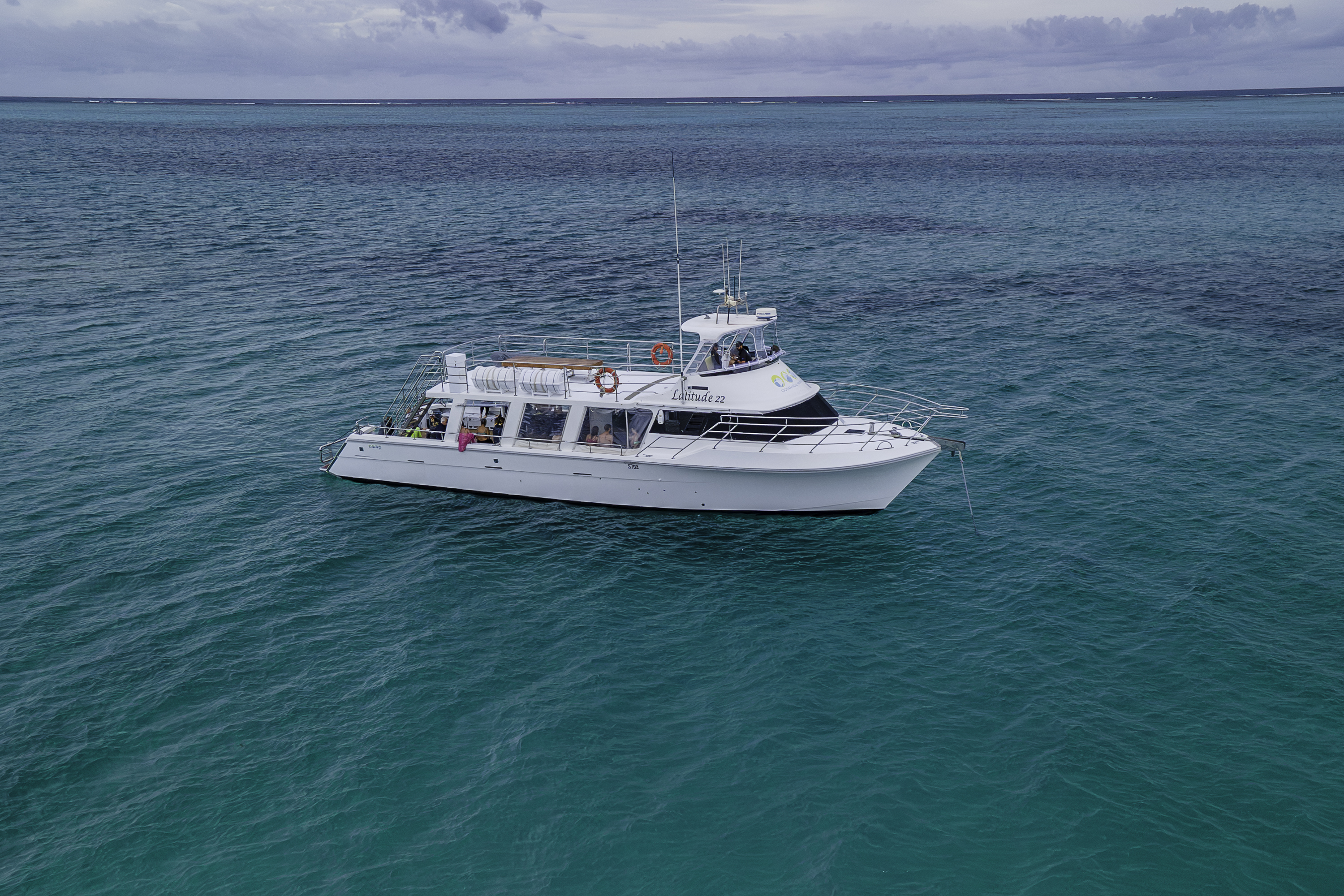
In January 2023, we invested approximately $300,000 in new-generation engines for Latitude 22, our 21-metre Exmouth vessel.
The upgrade reduced fuel consumption and emissions, replaced mineral engine oils with synthetic oils and extended servicing intervals — reducing the amount of lubricants, filters and other materials required over the engines' operating life.
Over the years we've also invested in more efficient vehicles, DC power aboard our vessel, improved desalination and air-conditioning systems, rainwater collection at our workshop and other measures designed to reduce energy and resource consumption.
For us, sustainability isn't about replacing everything overnight.
It's about continually asking, “Can we do this better?”

Wildlife Always Comes First
Of course, sustainable marine tourism isn't only about fuel and emissions.
It's also about how we interact with the animals that call Ningaloo home.
Our wildlife experiences operate under strict interaction guidelines, including maximum swimmer numbers and minimum distances from animals.
There is absolutely no touching, chasing or interfering with wildlife, and the same principle applies to the reef itself — look, enjoy, photograph, but don't touch.
Most importantly, the animal always has a choice.
If our crew believes an animal is showing signs of stress or doesn't want to interact, we move away.
Sometimes responsible wildlife tourism means knowing when not to have an encounter.
That's something we think is just as important as finding the animal in the first place.

Small Changes Add Up
Not every environmental initiative is as exciting as building an electric boat — but collectively, the smaller changes matter too.
Across our operations, we use reusable plates, cups, wine glasses and cutlery rather than disposable alternatives. We purchase in bulk where practical to reduce packaging and use reusable containers for suitable onboard products.
Our vessels are fitted with desalination systems that produce drinking water onboard, helping reduce our reliance on bottled water.
All rubbish from our tours is returned to shore for appropriate disposal, and cans and bottles are recycled through the facilities available locally.
We've also moved heavily towards digital systems.
Online bookings, confirmations, waivers and guest feedback have helped us achieve an estimated 95% reduction in paper use compared with our earlier operations.
They're not necessarily the things you'll notice when you step onboard.
But they're all part of the way we choose to operate.

Supporting Research & Education
We believe one of the most valuable parts of eco-tourism is giving people the opportunity to understand why places like Ningaloo are worth protecting.
Our guides don't simply point out an animal and move on.
Throughout our tours, guests learn about the wildlife they're seeing, animal behaviour, the Ningaloo ecosystem, current conservation issues and the importance of responsible interactions.
Ocean Eco Adventures has also supported marine research by making places available aboard our vessels for DBCA personnel, marine science students and researchers conducting monitoring and research within the Ningaloo Marine Park.
Our directors and vessels have also assisted researchers working in the region when opportunities arise.
Because the more we understand about Ningaloo, the better equipped we are to protect it.

Supporting Our Local Community
Sustainability isn't only about what happens in the water.
Where practical, we purchase locally and support other businesses within our region.
We also provide complimentary transfers on many of our tours, allowing groups of guests to travel together rather than everyone driving individual vehicles to departure points.
Within the business, we encourage car pooling where practical and operate and maintain our vehicles and vessels with fuel efficiency in mind.
Living and working in a remote community makes you particularly aware of where things come from, how far they travel and how much gets thrown away.
Whenever there's a practical opportunity to make a better choice, we try to take it.
Measuring Our Impact — Not Just Talking About It
It's easy for a business to say it's sustainable.
We think it's more important to understand our impact, set goals and keep looking for ways to improve.
Ocean Eco Adventures holds Sustainable Tourism Accreditation and EcoStar Accreditation through the Australian Tourism Industry Council's Quality Tourism Framework.
We've also completed a Tourism Emissions Reduction Commitment through Carbonhalo, which has allowed us to measure our business emissions and develop a practical plan for reducing them.
Our current plan identifies 27 actions across our direct operations, purchased energy and wider value chain, alongside longer-term renewable energy goals for our Exmouth locations.
And rather than keeping that information behind the scenes, our Carbonhalo Emission Reduction Dashboard is publicly available for anyone who would like to see it.
For us, these programs aren't about collecting another logo for the website.
They give us a way to measure where we are now, identify where we can improve and hold ourselves accountable for continuing to make better choices.

Sustainability Is Never Really Finished
We're proud of the changes we've made, but we don't think sustainability is something a business can simply tick off as “done.”
That's why we continue to measure our impact, set new targets and look at what comes next.
Technology changes. Better alternatives become available. And sometimes a small operational change can make just as much sense as a major investment.
From reducing paper and single-use products to investing in more efficient engines and eventually introducing an entirely electric vessel, our approach has always been about continuing to improve.
We also believe sustainable tourism doesn't mean people shouldn't experience wild places.
Quite the opposite.
When someone swims alongside their first Whale Shark, watches a humpback mother and calf resting in the Exmouth Gulf, or quietly cruises across the Ningaloo Reef aboard Wirraji, they often leave with a completely different appreciation for the ocean.
Our job is to help create those experiences without forgetting that we're visitors too.
Because Ningaloo doesn't belong to us.
We're simply lucky enough to spend our days here — and we want future generations to have the opportunity to experience it too.


Comments